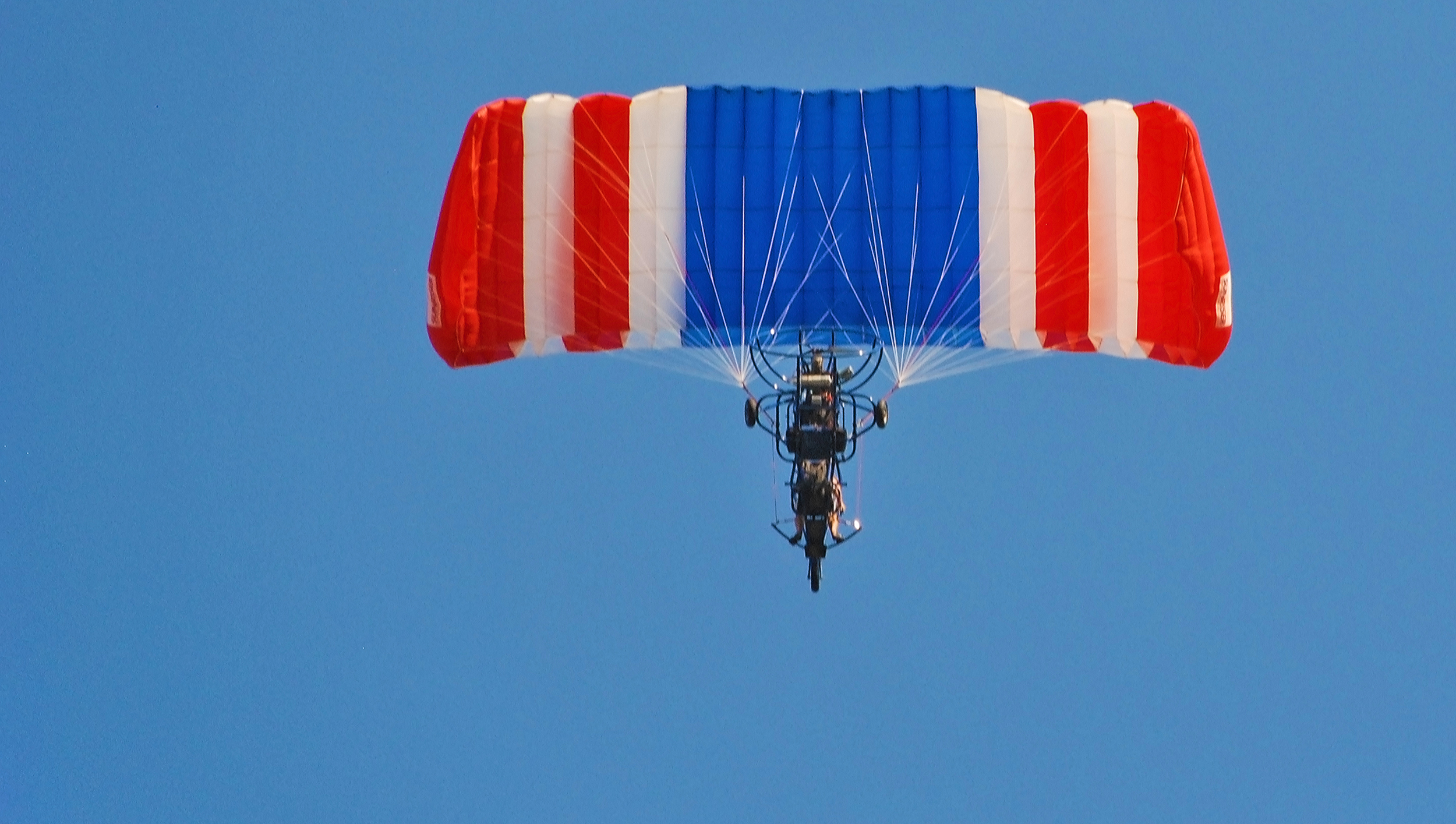
You are part of the way there already!
If you're a private pilot who would like to transition to powered parachutes or just pick it up as an additional privilege at the sport pilot level, you're already in very good shape. The FAA recognizes the work you've already done to become a pilot and does not expect any given amount of time for you to train in powered parachutes before you are able to get your sport pilot endorsement. However, they are concerned that you do achieve the same standards that others do. That means some amount of training on the equipment you intend to fly.
If you want to get an additional private pilot rating for powered parachutes, there will be a little more work involved. You will not need to take a knowledge test again, but you will have to get all of the dual training hours (including night dual training hours), just like someone starting out.
Part 103 — Ultralights
Like anyone else, if a pilot pilot wants to fly a single seat, 254 lb. or less empty weight, 5 gallon or less fuel capacity powered parachute, there are no regulatory requirements for training. The prudent pilot certainly seeks out some training since there are basic differences in the category from other types of flying. However, the amount of training required is determined by the pilot and not by the regulations.
Sport Pilot Powered Parachute
If you want to fly a powered parachute with a passenger, then you must get the proper category endorsement. You can choose to fly either as a Sport Pilot or a Private Pilot in powered parachutes. It is far easier to get the sport pilot endorsement for powered parachutes than it is to get the private rating.
If you're a private pilot that wants to get a sport pilot powered parachute endorsement, you must first work with a powered parachute Certified Flight Instructor (CFI) in order to complete your initial training. That CFI can then recommend you to another powered parachute CFI for what is called a proficiency check. (per FAR §61.321) The proficiency check is nearly identical to a regular Designated Pilot Examiner (DPE) practical test except that:
- You don't have to take a knowledge test if you hold a pilot certificate.
- You don't have to complete a minimum amount of training before the proficiency check.
- It can be done by another powered parachute CFI instead of a DPE.
Once you have completed the proficiency check, you will be able to take passengers along for the ride and, as a bonus, your proficiency check will count as a flight review!
Private Pilot Powered Parachute
The regulations provide for a specific powered parachute private pilot rating. Easy Flight is one of the very few places in the country where you can receive the appropriate training and sign-offs for that. The rules for a private pilot picking up the additional rating are very similar to someone starting out in aviation. The one big exception is that you do not have to take the Powered Parachute Private Pilot Knowledge Test like someone without a rating would have to. That aside, the requirements are the same.
- You must be at least 17 years of age.
- Be able to read, speak, write, and understand the English language.
- You must have at least a current third class medical.
- You need to complete the following flight experience requirements. (And no, your night flight experience in an airplane does NOT count. Sorry.) This is per §61.109(i).
- A person who applies for a private pilot certificate with a powered parachute category rating must log at least 25 hours of flight time in a powered parachute that includes
- 10 hours flight training with an authorized instructor*
- 30 takeoffs and landings
- 10 hours of solo flight training
- The training must include at least -
- 1 hour of cross-country flight training in a powered parachute that includes a 1-hour cross-country flight with a landing at an airport at least 25 nautical miles from the airport of departure;
- 3 hours of night flight training in a powered parachute that includes 10 takeoffs and landings (with each landing involving a flight in the traffic pattern) at an airport**
- 3 hours of flight training in preparation for the practical test in a powered parachute, which must have been performed within two calendar months of the date of the test; and
- 3 hours of solo flight time in a powered parachute, consisting of at least-
- 1 solo cross-country flight with a landing at an airport at least 25 nautical miles from the departure airport; and
- 20 solo takeoffs and landings to a full stop (with each landing involving a flight in a traffic pattern) at an airport
- 3 takeoffs and landings (with each landing involving a flight in the traffic pattern) in an aircraft at an airport with an operating control tower.***
- You need a recommendation from a Certified Flight Instructor who is himself a Powered Parachute Private Pilot*.
- You need to get a check ride from 1 of the 6 (as of 2019) Designated Pilot Examiners authorized to provide check rides for Powered Parachute Private Pilots. Roy Beisswenger is one of those four individuals.
The privileges of a private pilot powered parachute include all of those of a sport pilot and add the ability to fly at night, fly powered parachutes with more than two seats, fly heavier powered parachutes than sport pilot allows for, and be able to fly above 10,000 Feet Mean Sea Level. The privileges of a Powered Parachute Rated Private Pilot are the same as an Airplane Rated Private Pilot.
*Note: Much of the training for Private Pilot Powered Parachute can be conducted by any powered parachute CFI. However, things like night dual instruction and the recomendation for the practical test must be made by a CFI who holds the Private Pilot Powered Parachute rating. There is one important special exception. A Sport Pilot Powered Parachute CFI who also is a Private Pilot - Airplane Single Engine Land, can apply to the EAA for an exemption to do the recommending endorsements for a student working on his/her Private Pilot Powered Parachute Rating.
**Note: The night flight dual instruction is mandatory if you want to fly at night in a powered parachute. It does not matter how many hours you have flown at night as pilot of airplanes or helicopters. Since you are moving to another category, the dual flight training requirements have to be met. Now, if you don't want to fly at night, there is an exception that will allow you to get a private pilot powered parachute rating without flying at night. If you do that, then you will be issued a certificate with “Night flying prohibited”. This limitation may be removed by an examiner if the holder complies with the requirements of §61.109(i)(2), which is the regulation requiring night training for a powered parachute.
***Note: Notice that the requirement doesn't state that you have to fly a powered parachute at the airport with an operating control tower. You have to fly an aircraft. That means that flight time in an airplane will satisfy the requirement.